
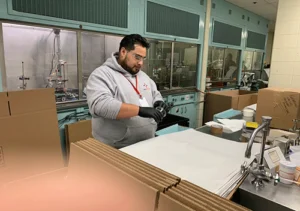
 Hingham Moving Services’ laboratory movers relocate labs for research institutions, universities, hospitals, and corporate R&D teams, whether the new space is across town, in another state, or overseas. Every job with our laboratory relocation services begins with an on-site survey and a bound quote. In-house, classroom-trained lab equipment movers then pack and load instruments from analytical balances to glove boxes, and one driver stays with the shipment from pickup to delivery.
Laboratory Relocation Services for Research, Hospital, and Corporate Labs
Hingham Moving Services moves research laboratories, university and academic teaching labs, hospital and clinical labs, biotech and pharmaceutical labs, corporate R&D operations, and government research facilities. Projects range from a single small laboratory to a large corporate research site, and some clients move a whole laboratory while others relocate only selected equipment. Our laboratory relocation services cover instruments, frozen biological samples, and everyday laboratory contents, with moves made locally, across the 48 contiguous states, and internationally. For international moves, we handle customs documentation and export compliance.
A laboratory move is different from an office move. Instruments need preparation before they are packed, hazardous materials fall under shipping rules, and some equipment must be retested before it goes back into use. The sections below cover each of these.
Lab Equipment Movers for Every Instrument Family
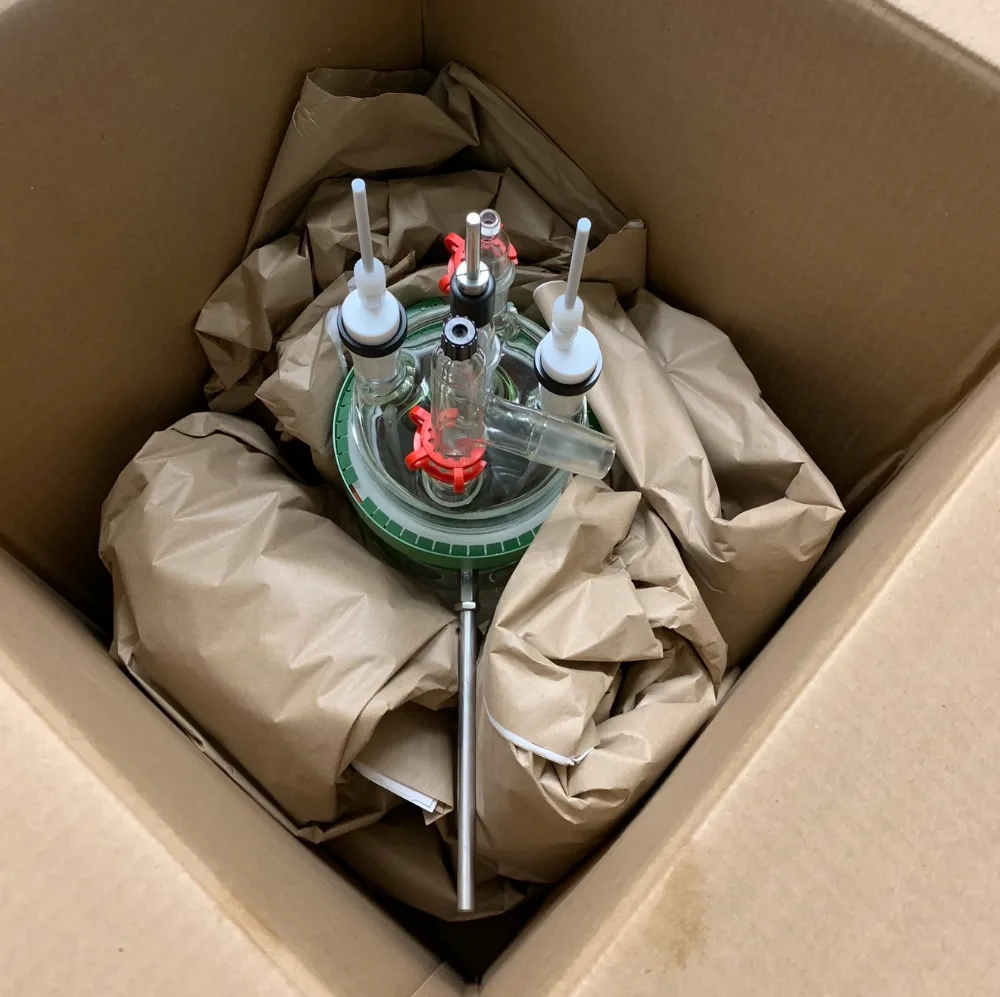
Hingham Moving Services’ lab equipment movers have relocated incubators, centrifuges, ultra-low freezers, HPLC machines, Zeiss and Olympus microscopes, biosafety cabinets of every size, and spectrometers of all types. Our crews have also moved pumps, glove boxes, clean rooms, cold room contents, PCR machines, microplate readers, sterilizers, imaging machines, and processing equipment such as autoclaves, bioreactors, fermenters, and lyophilizers.
Preparation differs by family: some units are drained, some need a manufacturer shutdown, and some must be decontaminated first. Crews pack each instrument in custom crating and shock-absorbent foam sized to it, with anti-static protection for electronics and climate control for temperature-sensitive units, so high-value equipment is protected the whole way. Air-ride, dedicated trucks carry the load.
| Instrument family | What we've moved | How it is prepared and moved | What happens at the new site |
|---|---|---|---|
| Biosafety cabinets | Biosafety cabinets of all sizes; laminar flow hoods | General practice: the lab or its contractor decontaminates the cabinet first. It is then crated and loaded on a dedicated truck. | Set in place per the floor plan. General rule: a qualified certifier field-certifies the cabinet before use (NSF/ANSI 49-2026). |
| Fume hoods | Fume hoods | General information: a ducted hood connects to the building's exhaust, so the building's facilities team or contractor disconnects it before the move. | General rule: performance testing after installation under ANSI/ASSP Z9.5-2022, by ANSI/ASHRAE 110 methods (110-2016, reaffirmed 2025). |
| HPLC and other chromatographs | HPLC machines; gas chromatographs (GC) | General practice: the owner books manufacturer service to shut the system down. Crews then crate it with protective foam. | Set in place and reconnected where applicable. The owner decides what IQ/OQ is required. |
| Mass specs and other spectrometers | All types of spectrometers, including mass spectrometers and spectrophotometers | General practice: owner-booked manufacturer service comes first, followed by crating and air-ride transport. | Set in place. The owner arranges manufacturer service and requalification. |
| Incubators | Single- and double-stacked incubators | Water-jacketed units are drained before transport. | Set in place per the floor plan. |
| Ultra-low freezers, lab freezers, and cold room contents | Freezers holding frozen biological specimens; ultra-low temperature freezers; cold room contents | Freezers stay plugged in and powered in transit, with backup power and temperature tracking. | Set in place and powered up. |
| Centrifuges | Centrifuges of all sizes, including refrigerated centrifuges | Packed to each unit's specifications for a dedicated truck. | Set in place per the floor plan. |
| Microscopes | Zeiss, Olympus, and other top-brand optical, fluorescence, confocal, and electron microscopes | Shock-absorbing packing protects the optics, and air-ride suspension cuts road vibration. | Set in place per the floor plan. |
| Glove boxes and clean room equipment | Glove boxes; clean rooms | Packed to each unit's specifications for a dedicated truck. | Set in place, then reviewed with the lab team in a walk-through. |
| Processing equipment | Autoclaves, bioreactors, fermenters, and lyophilizers | Packed to each unit’s specifications for a dedicated truck. | Set in place per the floor plan. |
Hingham Moving Services coordinates with the lab’s equipment vendors and service providers when needed.
Laboratory Chemicals, Hazmat Shipping Rules, and Chain of Custody
Labs searching for lab chemical movers should know that Hingham Moving Services offers no stand-alone chemical moves. Chemicals can be included in a full laboratory move, and we decide that with you at the on-site survey.
Hazmat shipping. Hazmat shipping falls under the U.S. Department of Transportation (DOT) Hazardous Materials Regulations, 49 CFR Parts 171-180. Under these rules, the party that offers a regulated material for transport must class it, package it, and describe it on the shipping papers, Hazardous Materials Table at 49 CFR 172.101. Anyone who prepares, loads, or transports regulated materials must be trained and then retrained at least once every three years, as PHMSA’s hazmat training requirements explain.
Who does what. Many universities publish laboratory move guidance that assigns these tasks. Under Boston University’s lab relocation guidance, lab staff and the move coordinator build the chemical inventory. The university’s waste contractor disposes of hazardous chemical waste, which is not moved, and chemicals travel only with an approved chemical contractor or approved individuals. The lab’s own duties come from the OSHA Laboratory standard (29 CFR 1910.1450), which requires employers to develop and carry out a written Chemical Hygiene Plan.
Chain of custody. A chain of custody is the written record of who had each item or sample, and when. The National Cancer Institute’s best practices apply chain-of-custody procedures to biospecimen shipments. On our moves, few hands touch the shipment. The driver who picks it up delivers it, and the crew that loads the lab also unloads it. The equipment list from the survey gives you something to check every item against at both ends. Truck tracking and a temperature log for each freezer show where the load was and how cold it stayed.
Frozen Biological and Cryogenic Sample Transport
Six safeguards protect samples during frozen biological transport:
- Generator-equipped trucks with a redundant backup generator system. If one generator stops, the second keeps the freezers running.
- Trailers with 110 V to 220 V outlets. Freezers stay plugged in and powered for the whole drive.
- Backup freezers on board. If a lab’s own unit fails at any point, the samples have a working freezer to go into.
- Temperature tracking for each freezer, with wireless monitoring. Conditions are recorded continuously from pickup to delivery.
- Freezers moved with the specimens inside. Samples stay in their own freezer for the whole trip and move to a backup unit only if that freezer fails, so they are not exposed to room temperature mid-move.
- Overnight and 72-hour delivery options. Labs can choose the shorter window for samples with less tolerance for time in transit.
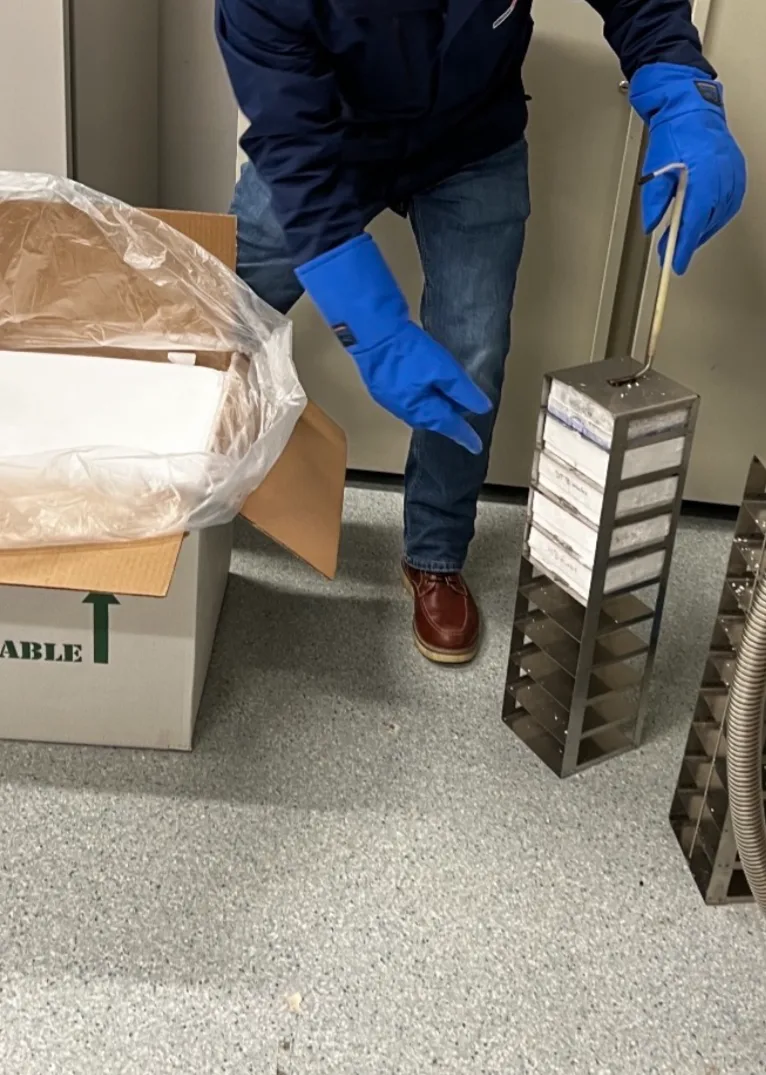
For packed shipments, frozen samples travel in insulated bins with dry-ice pellets, 4 °C items travel in standard coolers with gel packs, and a temperature probe measures each cooler.
For critical shipments, the National Cancer Institute’s Best Practices for Biospecimen Resources recommend a device that records temperature throughout transport. The per-freezer tracking above produces that record.
How the Laboratory Moving Process Works
Our laboratory moves follow four steps, each planned around the lab’s schedule to keep downtime short:
- On-site survey. A survey team visits the laboratory, and the new site where needed, to look at equipment, materials, and timing. Working from the lab’s equipment list, the team records each item’s dimensions, weight, handling requirements, and any calibration sensitivities.
- Custom plan and an upfront quote. The estimate is free, and the quote is bound, so the final price can come in lower but never higher.
- Packing and transport. Crews pack each instrument according to its type and load it onto a dedicated truck.
- Unloading and placement. The crew that packed the lab unloads it and sets each instrument where the floor plan shows. Equipment is reconnected where applicable, and the crew walks the space with lab staff before the job is signed off.
For laboratories that want us to coordinate the entire project, we offer full laboratory relocation management.
Planning how to move a laboratory should start early, because decontamination, chemical disposal, and vendor appointments all need lead time. For large moves, Stanford Environmental Health and Safety advises booking an advisory inspection at least 60 days ahead in Stanford’s laboratory move guidelines. That figure reflects one university’s policy, not a regulation.
We base your quote on what we see during the survey, so the price reflects your actual equipment, materials, and timing.
Reinstallation, Decontamination, and Requalification After the Move
Some equipment has to pass testing before the laboratory can use it again. Biosafety cabinets must be recertified, ducted fume hoods must be performance tested, and regulated analytical instruments need whatever requalification (IQ/OQ) their owner requires.
Decontamination. This step happens before the move. At Boston University, EHS decides which equipment needs it, and the move coordinator and lab staff do the work. Each decontaminated item then needs a “Decontamination Record” label, which is valid for only 15 days, so timing matters. The vacated space needs work too: decontaminating the empty lab, taking down hazard posters and labels, and disposing of leftover materials make up laboratory decommissioning. At the new site, keeping a laboratory clean after a move starts with clearing out packing materials, then disinfecting surfaces and each instrument per its manufacturer’s instructions.
Biosafety cabinet recertification. Biosafety cabinets are field tested at installation, at least once a year, and after any move. NIH’s biological safety cabinet requirements, issued by its Division of Occupational Health and Safety, call for decontamination before relocation and recertification afterward. Boston University has the same requirement. The field tests a qualified certifier performs come from NSF/ANSI 49-2026, the standard for these cabinets. The CDC/NIH BMBL, 6th edition addresses cabinet certification in Appendix A.
Requalification after the move (IQ/OQ). Installation qualification (IQ) documents that an instrument arrived as specified and is properly installed in a suitable environment. Operational qualification (OQ) documents that it operates to its operational specification in that environment. USP General Chapter <1058> counts relocation as a trigger. Relevant parts of IQ apply to a qualified instrument moved to a new location, and the owner then decides which tests, if any, to repeat. Under the chapter, the user is ultimately responsible for qualification.
Hingham Moving Services places and reconnects the equipment. The lab, a manufacturer service engineer, or a qualified certifier performs certification, performance testing, and IQ/OQ.
Lab Moving Crews, Guarantee, and Completed Lab Moves
Our own crews staff each lab move, and no part of the job goes to a subcontractor.
- Experience: decades spent relocating research, hospital, and corporate laboratories.
- Crews: in-house, classroom-trained movers who pass background checks and drug tests, with the same driver from pickup to delivery and the same team loading and unloading the lab.
- Insurance: our moving service insurance includes liability, workers’ compensation, and motor truck cargo coverage.
- 100% guarantee: payment comes due only once every part of the move is complete, as promised in the moving agreement.
- Bound pricing: the final price can come in lower than the quote but never higher.
- Fleet: well-maintained trucks with air-ride suspension.
Biogen frozen-sample move
When Biogen acquired Reata Pharmaceuticals, Hingham Moving Services moved frozen samples from Reata’s Texas site to Connecticut and to Biogen in Cambridge, Massachusetts. The crew prepared and labeled eight −80 °C freezers and four −20 °C freezers for the trip. Frozen samples were packed in insulated bins with dry-ice pellets, and 4 °C items went in standard coolers with gel packs. A temperature probe monitored every cooler. The truck drove direct, with four days in transit. Roughly 30% of the samples reached Connecticut on the afternoon of day four. The rest went into waiting freezers at Biogen in Cambridge the following morning.
University of Chicago to San Francisco full-lab move
We moved a full lab, frozen biologicals included, from the University of Chicago to San Francisco. Planning took several site visits. An eight-person crew started packing on July 16. The inventory covered water baths, analytical balances, thermal cyclers, HPLC machines, microscopes, and flow cytometers, plus two large glove boxes and three large biosafety cabinets. Packing and loading finished within three days. Two drivers then spent four days on the road, and unloading in San Francisco took place on day five.
Laboratory Moving Services by Location
Hingham Moving Services operates from four Massachusetts offices in Hanover, Woburn, Wellesley, and Millis. From there, we move laboratories locally, across the 48 contiguous states, and internationally.
Laboratory Moving FAQ
Yes. We work with the vendor or service provider as needed and keep a record of the move to support the instrument’s warranty status. Flag any instruments with active contracts during the survey so we can plan around them. The manufacturer’s contract terms set who shuts each instrument down and who restarts it, so it’s worth reviewing them before move day.
Equipment can go into our climate-controlled, bonded storage for as short or as long as the buildout takes. Frozen samples and powered freezers get their own plan, using the safeguards described in the frozen-sample section.
Yes. Standard lab equipment such as water baths, beakers, and pipettes moves with the instruments, and benches, casework, shelving, and freestanding storage can be included. We record them with the instruments during the survey, so a single plan and quote cover the entire lab. Casework built into the building isn’t included.
For planning steps and timing, see our guide on how to move a laboratory. When choosing a laboratory moving company, ask whether it uses its own crews, binds its quotes, and holds payment until the job is done.
Schedule Your On-Site Laboratory Survey
Every lab move starts with an on-site survey, followed by a free estimate and a bound quote. To schedule that first visit with our laboratory movers, contact Hingham Moving Services.